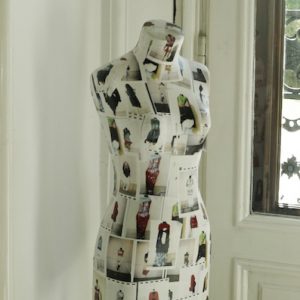
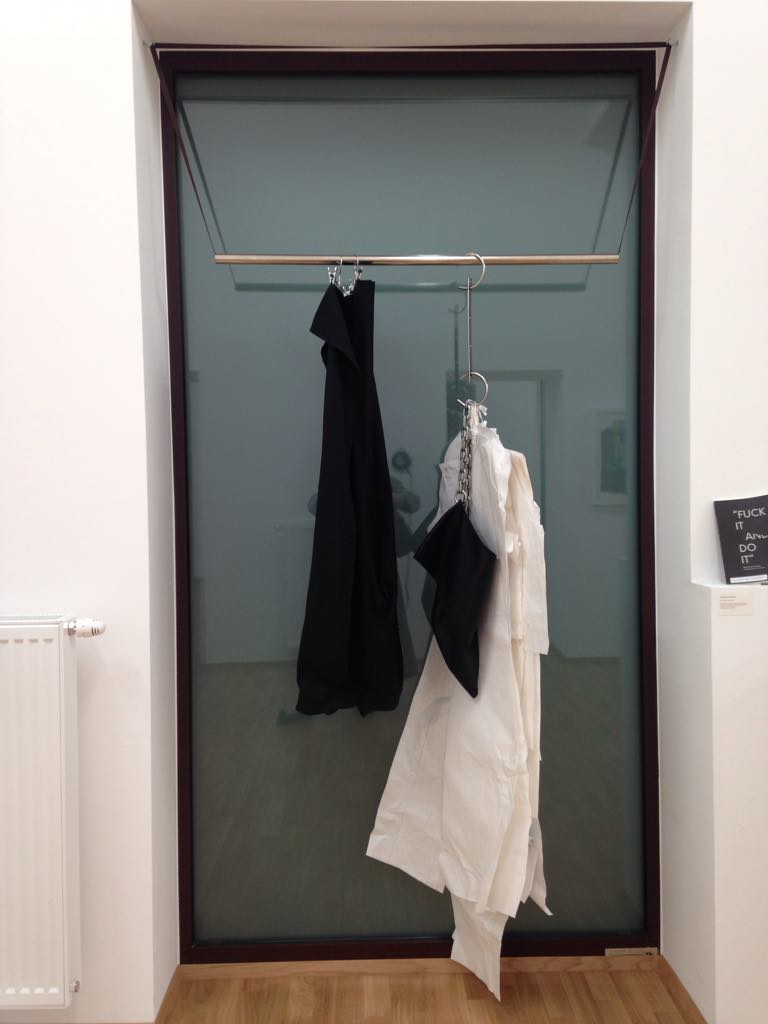
Picture above: Installation by Anna Schwarz
(Scroll for English)
Dieses Bild zeigt eine Installation von Anna Schwarz, einer jungen österreichischen Künstlerin. Das Objekt stellt ein Schnittmuster dar, das notwendig ist, um ein Kleidungsstück herzustellen. Auf diese Art wurde ich als Modeschülerin mit der Welt der Mode vertraut. Wir kreierten und produzierten Mode. Die besten Entwürfe wurden auf dem Laufsteg gezeigt und wir lernten zwischen der Welt der Konstruktion und der Welt der Präsentation zu unterscheiden. In dieser Terminologie konzentriere ich mich auf die Welt der Produktion, auf die Welt hinter der Coolness, die Laufstege und Bilder vermitteln.
Mit der Auslagerung in Niedriglohnländer wurde die Modeproduktion für die Konsumierenden in den westlichen Nationen unsichtbar. NGO’s haben sie wieder sichtbar gemacht um die ökologischen und sozialen Probleme, die damit einhergehen, aufzuzeigen. Die Enthüllungen waren schockierend und machten die dringende Notwendigkeit alternativer Produktionskonzepte deutlich.
Seither arbeiten Start-ups an visionären Technologien, welche die Produktion wieder in die lokalen Märkte zurückbringen könnte. Junge Handwerksbetriebe besinnen sich auf traditionelle Handwerkstechniken und interpretieren diese neu. Darüber hinaus gibt es Projekte, in denen textile Fasern wie Hanf und Leinen wieder lokal angebaut werden, um zukunftsorientierte Produkte daraus zu entwickeln. Auf industrieller Ebene soll Nachhaltigkeit durch die Digitalisierung gewährleistet werden.
Wie Walter Benjamin in seinem berühmten Werk ‚Das Kunstwerk im Zeitalter seiner technischen Reproduzierbarkeit’ (1963) feststellte, wurde die Malerei nicht überflüssig, als die Photographie aufkam, aber sie nahm eine neue Wendung. Ähnlich wird auch das Handwerk nicht von der Automation verdrängt werden – aber sie wird das Handwerk verändern. Mit Fashion Tech kommt eine aufregende Zeit auf uns zu – und die gilt es zu dokumentieren.
Die Nachhaltigkeitskrise der Modeindustrie erschöpft sich jedoch nicht nur in der Umweltproblematik. Auch die traditionellen Strukturen sind wachsender Kritik ausgesetzt. Im Fokus: soziale und kulturelle Ungerechtigkeit und unhinterfragte Schönheitsideale. Daraus hat sich ein spannender Diskurs entwickelt – und Strömungen, welche das System neu formen. Auch darüber lesen Sie auf dieser Website.
(English version)
This picture shows an installation by Anna Schwarz, a young Austrian artist. The object represents a pattern that is necessary to make an item of clothing. This is how I became familiar with the world of fashion as a fashion student. We created and produced fashion. The best designs were shown on the catwalk and we learned to differentiate between the world of construction and the world of presentation. In this terminology, I focus on the world of production, the world behind the coolness that catwalks and images convey.
With outsourcing to low-wage countries, fashion production has become invisible to consumers in Western nations. NGOs have made it visible again to highlight the environmental and social problems that come with it. The revelations were shocking and highlighted the urgent need for alternative production concepts.
Since then, start-ups have been working on visionary technologies that could bring production back to local markets. Young craft businesses are returning to traditional craft techniques and reinterpreting them. There are also projects in which textile fibers such as hemp and linen are being grown locally again in order to develop future-oriented products. On an industrial level, sustainability is to be ensured through digitalization.
As Walter Benjamin noted in his famous work ‚The Work of Art in the Age of its Technical Reproducibility‘ (1963), painting did not become superfluous when photography emerged, but it did take a new turn. Similarly, craft will not be displaced by automation – but it will change craft. With fashion tech, an exciting time is upon us – and it needs to be documented.
However, the sustainability crisis in the fashion industry is not limited to environmental issues. It is also a growing criticism of traditional structures. The focus is on social and cultural injustice and unquestioned ideals of beauty. This has given rise to an exciting discourse – and trends that are reshaping the system. Read more about this on this website.
 Not for Real